
I wore myself out to the tune of a $27 profit at Turfway Park and returned to my reeking room at the Newport, Kentucky Travel Lodge. Dexter Romweber, once half of the Flat Duo Jets, was performing a block away at the Southgate House. I took a shower, made myself more presentable than was necessary for such an occasion, and left.
As I was walking across the parking lot the night clerk rapped on the window and waved at me. He remembered me from my previous visit. This gesture of friendly recognition lifted my spirits.
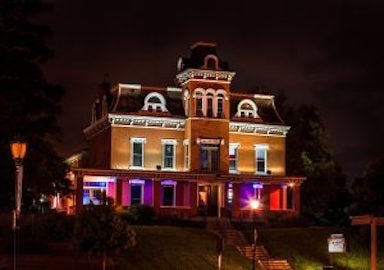
The Southgate House was a Victorian brick mansion. There were three floors and on each of them a separate musical entertainment was in session. A rockabilly band was playing in a narrow smoky room on the top floor. In the basement, which was the main room, a support act was warming up the sparse crowd for Romweber’s appearance. In the ground floor bar, a ‘cajun’ band were desecrating ‘Jole Blon’ and other standards. I sat at the bar, invisible as ever. For whatever reason, I passed through these parts unknown.
Romweber wasn’t due to take the stage for another hour. I walked across the street to the Newport On The Levee complex, a sprawling structure featuring the usual chain stores and fast-food restaurants, swarming with Friday night revelers. A neon sign on a side street made the interior look inviting, but once within it was the usual generic youth zone. I stood at the counter and ordered a bourbon on the rocks, which was poured stingily by a blonde-by-numbers bartender.
“Everybody likes that.” A rollicking old timer nudged me and gestured at the bartender’s ass. He was the only old timer in the place. He had been coming there for thirty years and lamented that the neighborhood clientele had been shunted out. When he left he shook my hand and introduced himself by name, Dennis. He had a family to go home to, grandchildren even. Throughout our brief conversation, much of it concerning the year he served in Vietnam, I had taken it for granted that he was single. When I see old men drinking or eating out alone, I always assume that they are single. It’s just wishful thinking.
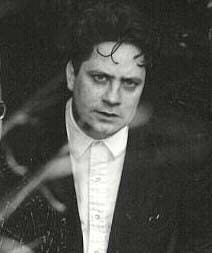
Back at the Southgate house, Romweber had taken the stage. Accompanied only by a drummer he alternated between heartfelt rockabilly ballads and lengthy berserk guitar solos that soared on the verge of collapse. He was in a heroically possessed world of his own up there, playing his eyeballs out to an audience of twenty people, whom he didn’t acknowledge. If he had he would have seen a group of boys and girls cavorting in a semi-comical manner on a spacious dance floor. I sat at the bar, getting pleasantly drunk, enjoying watching other people enjoy themselves. I hadn’t taken any pleasure in this trip because it had all been uninspired retread. I resolved to drive out of town the following day and open myself up to the possibilities.
Romweber finally stopped playing. The room was immediately drained of energy. The cajun band were serenading what remained of their audience in the upstairs bar. “Shit, is that Bob Dylan?” A drunk brushed past me. His lady companion followed close behind. “He looks like Bob,” she said, “that’s to his credit.” It was gratifying to find that I wasn’t invisible.
Through the front door a couple groped against a wall in the mist. I strolled back to the Travel Lodge, purchased a Snickers bar from the vending machine and retired to my malodorous room.
I woke up with a headache and left town.
A mean drizzle spattered the streets. I found my way onto the highway that winds northeast alongside the Ohio river. Gray skies, gray highway, trailer camps submerged in muddy water. One dreary little impoverished community after another, punctuated by refineries. Instead of the music enhancing the surroundings, the surroundings sullied the beautiful music on the car stereo.
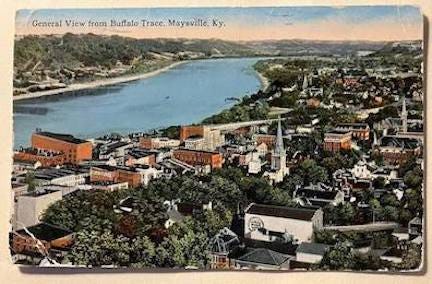
Maysville Kentucky looked tantalizingly pretty from the opposite side of the river. Up close it was another spent and closefisted small town. I parked outside an old theater. The crooked letters on the marquee advertised a bygone tribute show to local heroine Rosemary Clooney. The only open business was a Christian bookstore, and I was the one pedestrian. I get my hopes up, and it wouldn’t take much to keep them up: an old downtown hotel, a stretch of untarnished anomie. But even that is too much to ask for nowadays.
I couldn’t face any more of the river road. I took out the maps again. If I drove north I could be in Detroit by tomorrow afternoon, for what that was worth. Or I could drive south and repeat myself some more. I wondered about how open I really was to new experiences. I drove west, zigzagging rural routes for a long time before hitting a major highway. It continued to rain. I had assumed that I hadn’t enjoyed this trip because I hadn’t done anything adventurous, but once I attempted to do something new it got even worse. I tried to enter the modern world with a non-judgmental attitude. But it seldom lasted long.
I stopped in at a ‘family restaurant’ on the highway. The waitress regarded me with wariness and took her time. I wondered if I was being deliberately ignored. It wasn’t her fault. A morbid effluvia was surging through my veins, from which everybody I came into contact recoiled. Not that I often came into contact with anybody.
I forced myself to consume a plate of slop and got back into the car, not knowing what direction I was driving in. After about an hour I was in a fast-food landscape typical of big city outskirts. I had been spat back into the Cincinnati region and was spinning around the beltway. When it hit the 75 cut-off I made a quick decision and took the northern route, headed up the highway for about twenty miles until it felt entirely wrong, and turned around again. Driving back into the city didn’t feel right either but I lacked the energy or inclination to do anything else.
What was I doing there anyway? Driving in circles around Cincinnati on a Saturday afternoon in January. Mornings were non-existent, afternoons spent killing time around town in an uninspired manner, nights out at Turfway Park. I’d done it before, too many times. I was a lucky man.
I walked into the trees, pissed on a pile of dead leaves and watched the steam rising
I exited at Eden park and parked in a muddy lot near the art museum. I barely had the energy to get out of the car. After a while the need to pass water necessitated movement. I walked into the trees, pissed on a pile of dead leaves and watched the steam rising from them. The sun, such as it was, went down. I walked down the hill to Mirror Lake and circled it four times. Other than a group of camera-wielding Koreans who briefly surveyed the view, there was nobody else present. The yellow trees of autumn were now bare.
The fresh air and exercise were somewhat restorative. I drove down to the Clifton neighborhood and took tea at a cozy coffee house near the university. A short-haired, bespectacled woman sat at a nearby table. With head on elbow and pen in hand, she was bent studiously and gracefully over some papers. She wore a low-cut pink blouse and gray slacks; a few inches of flesh were visible above the sock. She kept a saucer placed upon her glass of tea and replaced it after every sip she took. I gazed at her with hopeless furtive longing. She stood up and donned a hooded sweater. I began to feel more alive and optimistic.
“Doctor,” said a man in the supermarket, tipping his cap at me as he walked by. “What?” “You look like Tom Baker,” he explained. I was reminded of the hazy erotic surge that accompanied the Dr Who theme when I watched it as a child. It was one of the first intimations of sexual awakening and had something to do with the dangers that threatened the doctor’s attractive assistant.
None of the local eateries were inviting to the solitary diner. They were all crowded with groups of people attempting to enjoy themselves... and couples. I found a plain Chinese restaurant. The only other customer was a willowy blonde. It was unusual to see a woman of such desirable surface appearance dining alone in an empty Chinese restaurant on a Saturday night. Moreover, her manner with the waiter indicated an equally attractive disposition. I stole glances at her from across the room but she never looked up from her food and left while I was in the middle of an unappetizing plate of mixed vegetables.
It was ten o’clock on a Saturday night, a fine time to check into a cheap motel and lie low. I put up at the Days Inn on Dixie Highway in Fort Wright, Kentucky. The rooms cost $39 a night and were refreshingly clean. I lay in the bath for several hours, reading George Gissing’s In the Year of Jubilee, and felt more at ease than I had been since arriving in that region, where the bluegrass meets the rust belt.
On Sunday night, at the end of a day like the other days—Pepper Pod for breakfast, Turfway Park for wallet-airing, Sitwell’s for tea—I went to the Comet Bar for a nightcap. It wasn’t a particularly thrilling prospect. Everybody seemed to know each other in there.
I walked in like an intruder. There were no seats at the bar. A bluegrass band were picking and grinning in the other room. There was nowhere to sit in there either. I stood at the back of the room, against the wall. Looking around, I took solace in the sight of the one other solitary man in the joint. The distinct lack of pretension in the air made me uneasy.
The musicians served up a rendition of ‘Molly And Tenbrooks’. In the middle of one song the mandolin player took a call on his cell phone, and kept the conversation going for several minutes while continuing to play. Through the hatch in the wall I could see that several barstools had become available. I took one of them, and sat with my back to the bar.
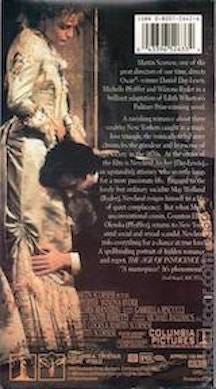
When I turned around, the stool on my right was now occupied by a slender young woman. Her hair was long and silky dark. It looked as if she had spent a long time combing it. Her eyes were a deep dark brown and her lips seemed almost unnaturally full, appallingly sensuous. She rummaged in her bag, took two video cassettes out of it and placed them on the counter in front of her: ‘The Portrait of a Lady’ and ‘The Age of Innocence’. It occurred to me that I hadn’t spoken to anybody in four days.
“Are you on a Henry James adaptation jag?” I asked.
“I don’t think they were both written by him,” she answered.
This was the response I had hoped for. It provided a way of keeping the conversation going.
“I saw The Age of Innocence,” I said. “Michelle Pfeiffer’s in it, isn’t she?”
“Yes,” she said, lighting a cigarette. “Are you a fan?”
“Not exactly.” To find myself conversing with somebody attractive after days on end of lonely meltdown sent me dissolving into giddy relief. Strangely enough, she seemed to be in the same state, with much smiling and laughter being released, accompanying even the most mundane utterances.
“Where are you from?”
I told her. Next, she wanted to know what I was doing in Cincinnati. I didn’t think it would go down too smoothly if I told her the truth: that I was an itinerant horseplayer drifting aimlessly and anonymously around her city, vaguely hoping to reconnect with a prostitute I met there a few months earlier.
“I’m working at the university,” I said, coming up with a story on the spot. “I’m studying advertisements for old blues records in back issues of the Chicago Defender, of which there exists a unique stash in the university library... mostly on microfilm. Somebody I know in California is putting a book of them together. It’s a labor of love really.”
As I had hoped, the esoteric nature of this explanation silenced any further inquiries. We sat there at the bar, each pretending to mind our own business, occasionally venturing into conversational territory. She was, without doubt, the most beautiful woman I’d seen since hitting town.
She fiddled with an ice cube on the counter, attempting to lift it, chopstick-style, with the aid of two cocktail straws. I tried it myself, likewise with futile results.
“It’ll melt before it moves,” I said.
We doodled on napkins. I drew a woman’s face and a flower. “A good Sunday drawing,” she called it.
“Funny you should mention that place,” she said after I eulogized the charms of Newport and the Pepper Pod cuisine. “I used to go there a lot, it’s owned by an ex-boyfriend-of-mine’s uncle.” This wasn’t to be her last reference to an ex-boyfriend. Another one, naturally, was in a band. They had worked together. She was now an assistant director at a nonprofit arts foundation. Her name was Louise. She was twenty-nine years old, Cincinnati born and raised.
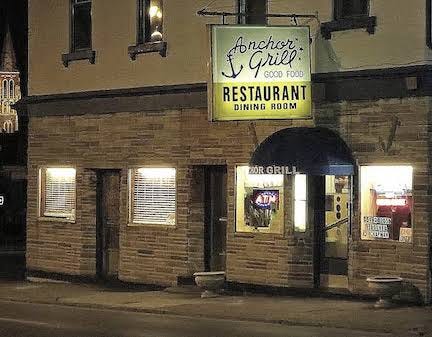
“There’s another diner you should visit over there,” she said: “The Anchor... the waitresses are really mean to you, and when you play the jukebox this curtain opens up just below the ceiling and there’s a stage with dancing barbie dolls and their mechanical puppet band.”
“I have to go there.”
The night before, on the motel room TV, I had watched part of an Elvis movie. At one point he was sitting at a nightclub bar with the potential love interest on a stool beside him. He asked if he could buy her a drink in such a charmingly casual and ingenuous manner that I thought it worth replicating, and it came out almost like an afterthought:
“Would you like to do something tomorrow night?”
“Yes,” she responded, straight and sweet. “We should go to the Anchor,” she said as she scribbled her number on a napkin.
I left that bar with a keen sense of accomplishment and anticipation. Cincinnati was still a charmed place. I checked back into the Days Inn.
I do not understand how people read books in the bathtub. There was a certain poet who was rich and had books printed on rubber pages, but that was a long time ago.
Days Inn Confused