HIT THE NORTH part 3
constantly ruing the latest version of what might have been

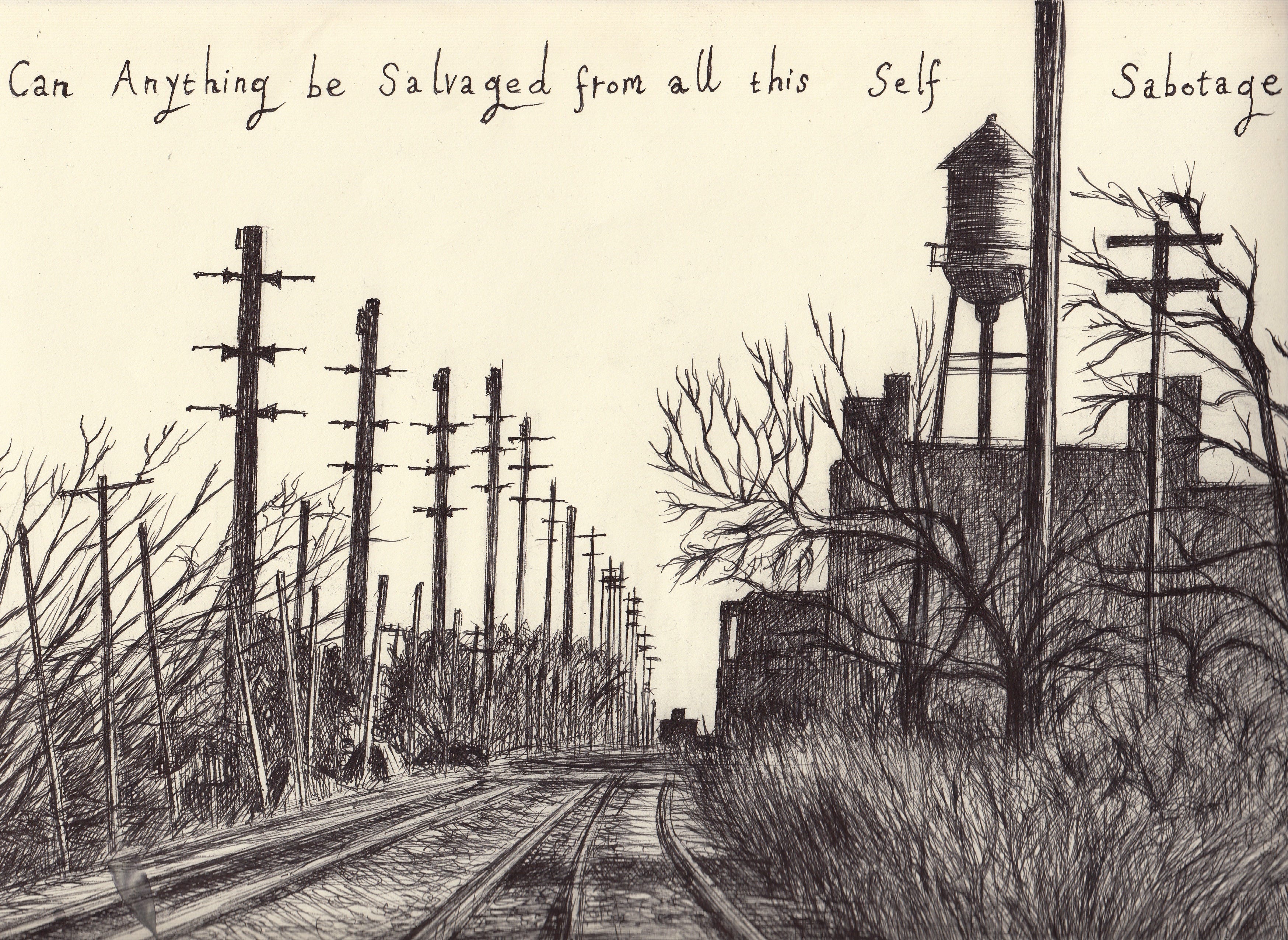
Leaving town was difficult but leave town I did, on waves of melancholic nausea, with the sun setting over the bare trees and lakes of northern Minnesota. For no good reason, when it would have been so easy to remain, I drove away from Hibbing.
It felt wrong, but I kept going. I stopped for tea at a Barnes & Noble outside Duluth, picked up a biography of Georges Bataille and read the words: “Avoid contact with all people in whom there is no possible resonance with what touches you most deeply.”
How many more times?
A placard covered with personal memories of Paul Wellstone stood outside the Democratic party headquarters on 2nd Avenue. The gubernatorial contender died when his plane went down a week earlier near Eveleth, just up the road from Hibbing. The tragedy was gripping the entire state, but I was more concerned with the minor-key tragedy of my latest drastic failure of nerve to pay much attention to it.
There was no need to return to Duluth.
Obviously.
Her features dissolved, fading uneasily into my future, receding into her past. Even before I left, I knew I’d regret leaving. It wasn’t as if I had pressing matters to attend to. I should have walked in like a lion when I entered the Sportsmen’s on Monday afternoon, not like a lost lamb. Stacey had obviously been talking about me to her friends and customers, all of whom seemed to know who I was. All I had to do was sit there for another twenty minutes and ask her out for a walk. It was the place and it was the time. You live but once.
“What brings you to Superior?” asks the female night clerk at the front desk.
“Well, you know I’ve always wanted to stay at the Androy Hotel,” I say, quipping in an agreeably merry tone that takes me by surprise.
“Sure,” she laughs.
But that’s the truth, the sad part, one of the sad parts. And I already had stayed there, but I didn’t tell her that, not wanting any witnesses to my meaningless repetition.
I can’t get out of bed. I lie there for hours, haunted, disgusted, demoralized, emptier than ever for the lack of an experience I should have fully embraced, watching the winter glow shimmering through the orange polyester curtains.
If I was capable of it, rather than living dutifully and artfully, I could resort to the cop-out of making art out of unlived life. But I couldn’t bring myself to do anything. The failure of nerve in Hibbing brought everything to a grinding halt. Eventually I got out of bed, opened the curtains, and viewed the gray smokestacks billowing over the lake from the seventh-floor window.
Unable to get out of the car, unable to do anything but blurrily chastise myself while parked in an insalubrious West Duluth neighborhood, I read the liner notes of a Jackson C.Frank CD and vainly wondered if the destitution, insanity and early death that befell this unlucky singer might await me. I slipped the disc into the player and ‘Milk and Honey’ played as I drove out of town, passing the Duluth Armory, where Dylan saw Buddy Holly perform on the latter’s last tour.
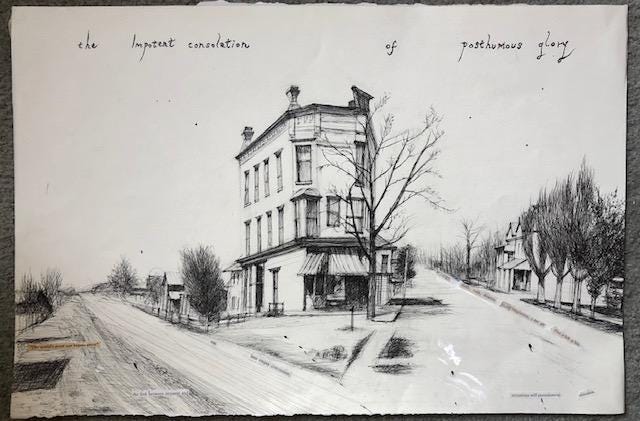
A muzak version of ‘Little Green Apples’ filled the air, piped onto the streets from speakers on each corner, a fitting soundtrack to the emptiness of a bleak Tuesday afternoon in downtown Eau Claire, Wisconsin, where I somehow found myself.
A few students sat in the wooden booths that lined the windows of a corner-coffee house. I ordered the half-sandwich and cup-of-soup combo, and immediately regretted it. Not knowing what to do with myself, I got back in the car and got lost driving around a tangle of bland residential streets. I considered leaving town but knew that I would only find myself somewhere even less appealing. I drove back downtown, entered a bar called Clancy’s, stood with my back to the smattering of patrons, drank a beer, looked out of the window, and saw nothing.
I rented a clean and spacious room on the third floor of a four-story red brick hotel a couple of blocks off the main street, at the very reasonable rate of $42 a night. I looked out of the window at a rickety gray warehouse upon which the last fading rays of daylight were falling.
In its lonely way it was a friendly town. Lights shone cozily in the windows of houses and apartment buildings, and the few people I passed on the street greeted me. I combed through a few albums of 78 records in a musty pawn shop that was mostly filled with guns and DVDs. Then I entered another coffee house.
I sipped the weak tea and continued to brood
After serving me lukewarm tea, the man behind the counter graciously reheated the water. He was of German extraction and had moved to Eau Claire a few years earlier to be with his wife. It was apparent from the wall hangings and the scattered literature that this was a Christian establishment. I sipped the weak tea and continued to brood over my failure of nerve. This time yesterday all I needed was sustenance of a gastronomical order to hold myself together until Stacey got off work. She was washing glasses on the other side of the bar, directly in front of me. We were physically close, connected, and that’s the way it had been since we met. I could have ordered a meal in the bar. Several people had suggested I do so. There had always been others around. So what? That could have been easily remedied if I’d had the sense to invited her to hang out when she got off work. I considered the not unthinkable possibility of returning to Hibbing.
A stranger wandered in, loudly inquiring about how much a cup of coffee went for. Upon noticing a chess set he asked an aquiline-featured man who was sifting through papers at a Formica table if he wanted to play. The latter begrudgingly agreed to give him a five-minute game. I sat at one of the computers and checked the horse racing results I’d missed over the last few days.
Due to the lack of dining alternatives I found myself at the same place that made me queasy earlier, opting again for the revolting half-sandwich and cup of soup combo: this time the salami and cheese sandwich, made of the cheapest luncheon meat—a horribly melted mess that induced further biliousness.
I coughed up $2.50 to see Mamma Mia at the old downtown theater, just for the fun of it, and thinking it might be amusing to hear Pierce Brosnan sing. It wasn’t, but I was rewarded with the experience, for the first time in my movie-going life, of being the only member of the audience. After an hour I left, telling the boy at the box office that he could go home.
Beneath a yellow marquee, the Mousetrap Tavern. A long bar stretched down the room to an empty game area that contained pool tables, dart boards and other amusements. Parallel to the bar was a darkened room where a number of grubbily-attired men, all beards and sweaters, were playing poker.
The clientele was relatively bohemian by the standards of small town Wisconsin. The bruiser on the nearest stool kept playing the Doors on the jukebox, and they sounded great. Morrison was singing his own death, forecasting and romanticizing it from the very beginning—‘The End’—of his career. He was often maligned these days, regarded as a figure of fun by envious men, and because the image he projected has been degraded, to death, by shabby imitators. Such profundities wafted through my mind as I ordered another cocktail and walked over to the card table. The rats in the Mousetrap were playing Texas Hold ‘Em, no limit.
A short cherubic kid with wisps of hair sprouting from pudgy features sidled on to the barstool next to mine and inquired with an ominous friendliness after my presence in town. Not wanting anybody to be party to my aimless meandering, I told him I was just passing through while visiting friends in Minneapolis. His name was Taylor and he worked at a local restaurant. He couldn’t take it anymore. He had tried in vain to introduce the locals to more adventurous culinary fare but their palates were inured to blandness. His dream was to become a sushi chef, and towards this end he wanted to attend a sushi academy in San Francisco, but saving up the necessary $5,000 was proving to be a problem. He complained vehemently about his next-door neighbor. “There’s a difference between a black and a n—-r,” he said, and proceeded to illuminate me as to the distinction, using this neighbor as an illustration of the latter type. I wondered how he might fare if he ever did make it out to California. I asked him about the poker game but he wanted nothing to do with gambling: his uncle, a pool shark, had been murdered.
I walked over to the card table, sat down and bought in. The bearded character at the end of the table, hunched over his chips, was raking it in. There were four other players, all similarly grimy and hirsute (strangers in town are immediately indentifiable: they’re clean-shaven). There was no conversation between the players. The fellow sitting directly opposite me fixed me with a hostile stare, which I held until he turned away. He probably took me for a city slicker, or a queer. The best player got up and lunged his way, with dragging leg, across to the bar. Taylor walked over, pulled up a chair, and sat down behind me. Nobody else at the table acknowledged him. I wondered if he was a local pariah and if his attachment to me reflected unfavorably upon me in their eyes. I won two hands and could have won more if I’d been braver but I wasn’t able to get into the rhythm of the game or figure what I was up against, and I didn’t care. Nobody said anything when I got up to leave, forty dollars worse off, except Tayler, who bid me goodnight.
The piped muzak was no longer playing on the street. I thought more about returning to Hibbing and atoning for my failure of nerve. Why not? It was only a three-hour drive.
Biliousness is such an underused word
I love your art. Do you offer your art for sale? If so, where would I go to do that?