
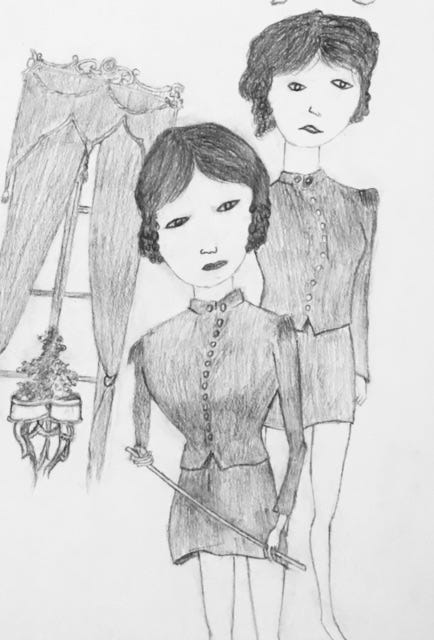
After dinner, Grace walked around the table, pulled up the chair next to mine, rested her feet on the rung of my chair, and sat there, a few inches away, staring at me, or at least I assumed that she was staring at me, as I remained with my face in profile, looking straight ahead, motionless but wriggling inside like a cornered creature: ensnared, appraised, and apprehensive.
She probably expected me to turn around, gaze deeply into her eyes, and reignite the flame that had burned so brightly between us twelve years earlier. That was a long time ago, and we had hardly spoken since then. But in recent weeks she had been texting me with a peculiar persistence, culminating in an invitation to join her for tea.
I had been attempting to look forward to the occasion. These plague days were hard on single people and Grace was one of the more stable women I’d ever been romantically involved with, although, admittedly, that bar was very low.
We sat on her porch, drinking wine. Since we had barely spoken to each other in fourteen years there was a lot of ‘catching up’ to do, but it was quickly exhausted, and we moved on to discussing the fate of various mutual friends.
“Do you still see Sam... V-v-v-v.... what was his name?” she asked.
“Vaddeshse. I saw him last week. He lives a few blocks away, with his wife and daughter.”
Grace smiled. “Ah, so he grew up.”
“If that’s what you want to call it, yes. It’s a shame that growing up is always defined in exactly the same way. If there was a dictionary entry for it, I suppose it would read: getting married and having kids. Yes, he made a choice and he’s sticking to it, or he’s resigned himself to it. I suppose that’s the grown up way of doing things. In that regard, I’ve never evolved.”
“You have in other ways, Edward,” she said, with a look of challenge in her eyes.
“Any word from Keith?” I asked.
“I had dinner with Keith and Calandra at their new house the other night,” she said.
“New house?” My ears pricked up in consternation.
“Yes, they bought...” said Grace.
“You mean she bought it?” I said, assuming this to have been the case, since, as far as I knew, my old friend was supported by his girlfriend or wife or whatever she was.
“No,” said Grace. “They bought it. Keith came into some money.”
“That’s nice,” I said with irrepressible disgust. “I’m happy for them.”
I decided not to let it bother me. If I got upset every time a friend suddenly bought a
house, seemingly out of thin air, I’d be in a constant state of torment. It was fairly easy to predict this over-familiar scenario by now, although it could still come as a shock when some people abruptly turned their lives around: when the time arrived to show their hand and reveal what they had been holding, or withholding, all along - when people who had been playing broke for years finally exhibited the wealth they had always known they were going to come into, which served as the secret wellspring of their confident and carefree natures: a state of mind that was often entirely attributable to freedom from financial worry, otherwise known as freedom.
One often wonders how people with no visible income get by. The answer is always
the same: they subsist on the kindness of relatives, or they are supported by their partners. And here I was with Grace: a woman of sound mind, independent means and mature beauty. If I made the right moves, I could throw my lot in with her and sponge off a spouse, as so many of my other male friends did.
I sometimes regretted that I hadn’t been able to bring myself to make such a potentially emasculating compromise with complacency. Time was marching on and the long-resisted notion of an honest partnership between a man and a woman no longer seemed like such a bad idea. Perhaps it was a fundamental aspect of life that was worth working on. The problem—one of the problems—was that by the time you were ready to give yourself over to somebody else, nobody wanted you anymore... other than people you didn’t want.
The information about Keith’s acquisition of property had sent me plummeting straight down a black hole that I couldn’t dig myself out of owing to the demands of making polite conversation. I didn’t feel like talking. I wanted to leave so that I could gather my thoughts and brood morbidly in peace.
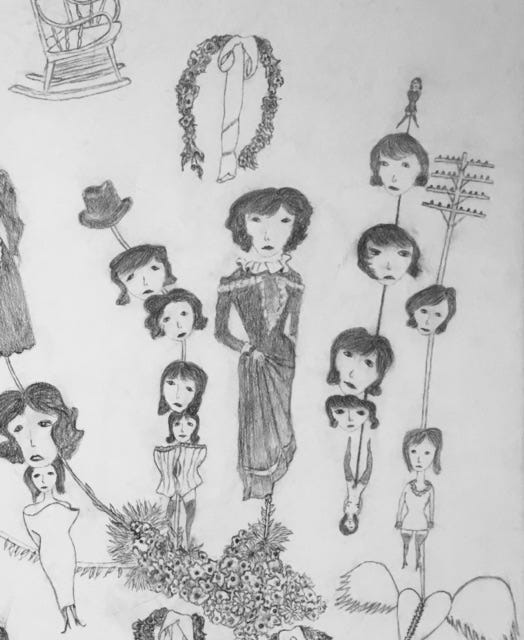
“What are you doing for dinner?” asked Grace, her cool, clear voice cutting into my abstraction.
“I don’t know,” I said, unprepared for any further demands upon my company, and with no plan in place for wriggling out of such an invitation.
“I could send out for some Indian food,” she said. “I know you like that.”
“Sounds good,” I said, concerned about how to keep the conversation going for another two hours or so.
The cat clawed its way onto my lap and began making herself comfortable.
“Billie knows a nice spot when she sees it,” said Grace, as shamelessly flirtatious as ever.
“I’m sure she’ll sit in anyone’s lap,” I said, as I tentatively stroked the cat. When I looked up again, Grace was glowing tenderly at me. She seemed to take a keen pleasure in watching me connect with her cat.
“Billie’s very selective about whose lap she sits in,” she said with an insinuating smile. “You’ve got nice hands, they haven’t changed.”
“I don’t know about that,” I said, looking down at them.
“You still have your freckles,” she said, caressing the stem of her wine glass as she spoke.
“Those aren’t freckles,” I freely conceded. “They’re liver spots.”
The more she flattered me the more uneasy the silences became. I dimly remembered how easy it used to be for us to be silent together. But that was back when we were having sex. She could get away with that heavy-lidded routine back then, but if I had ever carried a torch for her, the flames had been doused fourteen years ago. Ours had been a whirlwind romance and a whirlwind breakup, and she was soon married to the man she had lined up as my replacement—a marriage that she now cheerfully described as “failed.” Whether there had been any overlap between our passionate affair and the uninspired union that succeeded it was a question that had tormented me at the time, but I had long ago ceased to think or care about such matters, and now it embarrassed me to remember that it had once bothered me so much.
I reached for the cat and quickly withdrew my hand
The silences broadened and intensified. I reached for the cat and quickly withdrew my hand, realizing that my stroking style was going to be scrutinized and perhaps misconstrued as a precursor of other strokes to come.
“Would you like some nuts?” offered Grace.
“Unfortunately not. My teeth can’t handle them.”
“Your teeth look fine from here,” she said, narrowing her eyes.
“I’m lucky that the best ones are in the front,” I said, squinting back at her. “It’s a
rotting graveyard back there, jagged islands in a sea of pain. If I lose one more molar I won’t be able to mast... ” I stopped myself, concerned that if I said the word ‘masticate’ the conversation might spiral into a sludge of excruciating innuendo: “... chew at all. I’ve been using this special toothpaste, and it seems to be helping.”
“You probably brush too hard,” she said with a fescennine smile. “I know how you are.”
“Yeah, maybe,” I said.
“You only need to do it three times a day,” she added, with widening eyes and an even more ghastly smile.
This time I had to laugh, if only to break the tension. We grinned at each other helplessly, but I kept the conversation going for fear of further derailment: “Yes, I started using this special toothpaste, it’s quite expensive...”
The food arrived and we moved inside. We ate our curries at her dining table, off floral plates, on vintage floral place mats, surrounded by fresh-cut flowers carefully arranged in vases, and we talked safely about music.
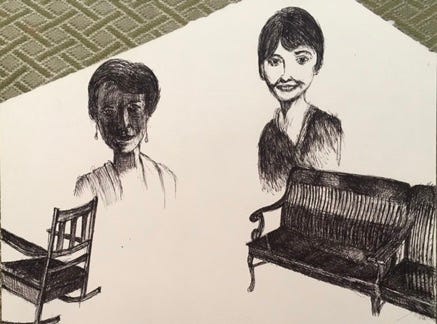
After dinner, Grace reached her hand across the table until it touched mine, which was resting beside my wine glass. My first instinct—and my second instinct, and my third—was to withdraw my hand, but although inwardly flinching, I maintained my composure and attempted to allow a certain pliancy to my movements in order to accommodate her now discomfortingly brazen intentions. Her fingers were weaving in and out of mine with delicate avidity. I shuddered and attempted to return some of her feeling, but my hesitant stabs at warmth only encouraged her to intensify her stroking, which was becoming increasingly less subtle. It was difficult to feign feeling when it came to hand-holding. I looked down at the table, checking my facial expression, stopping myself from sneering or frowning, and avoiding her eyes for fear of her loaded gaze.
“‘Sweet drops of calm blackness.’ What d’you think of that, Edward? Can it be improved upon?” said Grace, breaking the tension by picking up an anthology of poetry from the table and reading from it.
“I’d have to see the original,” I said, welcoming the opportunity to release my hand and reaching eagerly for the book. Grace didn’t read Spanish, but I did. Back in the day we had spent many post-prandial and pre-coital hours working on translations together, with her helping to refine my preliminary renderings.
The Spanish original was on the other side of the page: “Sweet drops of leisurely blackness” would be truer to the original, but still not quite right,” I said, restoring the tension.
“How about ‘darkness’?” said Grace with a knowingly suggestive smile. “‘Sweet drops of leisurely darkness.’ That sounds just right, and it sounds like you.”
Her hand had found mine again. It was irritating and slightly flattering that she was making her needs so palpable, and considering how it had shaken out between us, it seemed... wrong. She was thirteen years too late. I had passed through all the phases of getting over her long ago, and on this stage, at this late stage, the femme fatale act was getting a little tired and silly. Now I was expected to be responsive to these touchings - either that or inflict rejection upon her, which introduced another element of awkwardness that I had no desire to negotiate. I didn’t want to shame her by throwing the useless teasing of a stonewalled vamp into cold relief.
It was saddening that the memory of a special time was being tarnished by this slight return. Waves of melancholy washed in, behind a weak grin, and called forth gloomy reflections on fate and the passing of years. The fleetingly entertained notion of an honest partnership had dried up quickly once again.
The record came to an end and when Grace got up to change it I took advantage of the opportunity to make an unneeded visit to the bathroom, where I heaved out a long sigh of pent-up despair.
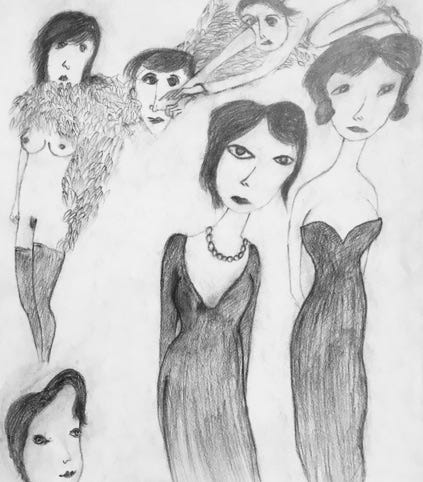
On the way back, rather than sitting down and subjecting myself to more heavy- handed tenderness, I stopped at the bookshelves. I pulled out a copy of Iris Murdoch’s The Black Prince. “Whenever Iris Murdoch writes from the perspective of an embittered middle-aged man with frustrated artistic aspirations, she nails it,” I remarked. “I don’t understand how she does it.”
“Men do it too,” said Grace, joining me in front of the shelves. “Lawrence, Henry James, Tolstoy, of course.”
“It’s hard enough to create a female character, but to write from the perspective of one seems impossible. I’ve never tried it,” I said.
“Maybe you should,” she said.
“It lies beyond the limited range of my capabilities,” I said.
“I’ll bet you could do it,” she said.
“It might be a good idea, under the circumstances,” I said. I sat back down, and Edward pulled up the chair next to mine. His fingers were soon creeping across the edge of the table until they were touching mine, just enough to make an impression but not enough to justify resistance. I didn’t want to hold hands with him but he was doing it in such a subtle way that it was difficult to repel. It seemed that he had been leading up to this all evening, and it made me uneasy.
“I love your new work,” he said.
“Thanks,” I said.
“It really pleases me that you’re doing so well,” he added.
I opened my mouth to remove some broccoli from between my teeth
“Am I?” I said, deflecting the insincere compliment and opening my mouth to remove some broccoli from between my teeth. The wine had loosened me up. I resented Edward for getting me drunk, among other things.
His fingers were pressing into mine as if previewing pressures and pleasures to come, while probably turning over some salacious details from the good old days in his mind. The sex had been good, I’d give him that. He was ten years older than me, and he knew what he was doing. But it would be impossible to recapture that potent old dynamic. You couldn’t lust after somebody you got over sixteen years ago. It would fizzle out like a fat candle with too thin a wick. Edward must have known this but he continued to act as if the old magic would just snap back into place despite all the muddy water that had flowed under the long-ago collapsed bridge.
“When I consider the amount of time I’ve spent searching for le mot juste over the years,” said Edward, with a smug leer.
“Maybe you were looking in the wrong places,” I said.
When I consider how you kicked me to the kerb all those years ago, I said to myself. An epistolary dumping was quaint but it hardly compensated for the coldness of the act, and two months later, perhaps less—I still sometimes wondered about that—he was joined at the hip to a woman whose surprisingly unappealing surface appearance, talentlessness, and overall less-ness, didn’t ease the sting of the break up. To add insult to injury, whenever I had the misfortune of encountering them in public together, which occurred with annoying frequency, they were always touching each other, making a sickeningly insensitive and self-congratulatory display of their newfound happiness, which didn’t last long.
And now, as if seventeen years hadn’t passed, he expected me to be at the ready when he called, willing to drive over to his squalid bachelor abode and submit to being sensitively groped. He had probably ransacked his mind for exes who might be amenable to his overtures, and knowing that I was currently single—having recently extricated myself from yet another disastrous entanglement—lighted on me as a likely prospect.
There were a lot of lonely men, and women, out there—those of us who had endured the lockdown alone. Social opportunities were rare and were usually taken when they were offered. Edward had finally worn me down, and out of curiosity, loneliness, and a misguided sense of obligation, on this the third occasion he had reached out, I accepted the invitation. Maybe I shouldn’t have, if it meant giving him hope.
Apart from even more stacks of books piled around the room in a manner that might appear haphazard to somebody unaware of Edward’s compulsive nature, more torn furniture, and several additional layers of dust, time had stood still in that apartment.
He moved a finger around the palm of my hand in supposedly soothing circles and began squeezing my wrist with determined intent, while with his free hand he picked an anthology of poetry from a nearby chair, upon which a pile of books reached to the top of the backrest, and began declaiming Verlaine in mangled French: “‘Et les yeux, les pauvres yeux si beaux ou point, La douleur de voir encore du fini.’”
I corrected his pronunciation, laughingly replacing “yo” with “yer.”
“Doesn’t it always sound absurd when Anglos attempt to carry off a French accent with all its native sensuality?” he said.
“No, only when you do it.” I said, flirting against my will. Well, we were just two lonely people sitting together in a room, in a time of strife. What did it matter?
Edward was one of those precious types who imagined that learning other languages would diminish his apparent mastery of his mother tongue. He had confided this to me once, and I had had to remind him that Nabokov, Joyce and Beckett were all polyglots.
“And the eyes, the poor beautiful eyes, the sadness seen more in the end,” he said, putting some feeling into it and staring deeply into my own poor eyes with a calculatedly vulnerable charm.
Without freeing my hand, he showed me the page. “Those poor beautiful eyes that have seen the sorrow of always looking towards the end,” I said, translating as I went along. “No, that’s still not right.”
“It’s good enough,” said Edward, tightening his grip around my wrist with an affectionate hint of threat and the intimation of a power he no longer possessed. Much as I loathed to resort to such a hackneyed term, it was... inappropriate, and just plain sad. There had been a time when he held sway over me, when, in fact, he had it all, or could have had it all, including me, if he’d done anything with his natural talent and charm. But he hadn’t done much with it, and now he seemed to be running out of road.
“‘That word Grace in an ungracious mouth is but profane,’” he said, and fixed me with a questioning, penetrating gaze, as if this oft-quoted line from Richard II provided a note of finality to all his meandering flirtation. Not that old line again, I groaned. The poor man had turned into a dried-up font of recycled flattery and exhausted quotations: he had bombarded me with that one back in the day, and perhaps this was his way of attempting to revive the spirit of those more passionate times.
I looked down at his wrinkled, blue-veined and liver-spotted hand as it slithered around mine in shameless simulation, and I was reminded of my father. If love was a combination of lust and pity, then the latter, after all these years, was all that remained. It wasn’t an age thing... Yes, it was an age thing. I had always been attracted to older men, but there were limits: Edward was really old now, and his station in life was stationary. I didn’t like looking at him, especially into his eyes, especially when he looked back into mine, shakily imploring me behind a steady gaze. It induced that old fragile feeling, refined with age to a caustic melancholy. Mostly it made me sad about other things and other people, and I wanted to leave so that I could give myself over to thinking those other things through. I didn’t feel like talking. I wondered if Edward could even get it up anymore.
“I mean,” she was saying, her words infringing softly on my reverie, “... at least you would be trying. A writer should be able to write from the perspective of the opposite sex. You can’t go through your entire writing life without at least trying it.”
“It seems presumptuous,” I said. “It requires an insight and audacity I don’t possess.”
“Why don’t you just take a woman from real life,” said Grace.
“I don’t want to risk hurting anybody’s feelings,” I said, weakly.
“Then what’s the point of writing?” she said.
“Good point,” I said.
Was this how it was going to be from now on, with those of us who had failed or not even made an honest attempt (at love) resignedly pairing off with each other now that the game was almost over? That seemed to be the case, and it gave me a deeper appreciation of the alternative: that of a simple, solitary life. I got up to say goodbye and we hugged, for a long time. It was the first physical contact I’d had in months and it felt good. She steered me towards the bedroom. I got into bed with him. What the hell. Why not? One last hate-fuck, for old time’s sake.
Santa Monica Review, 2022
Love the drawings too
Nice switch of narrator…