An American Trilogy
time is honey and the past is paste

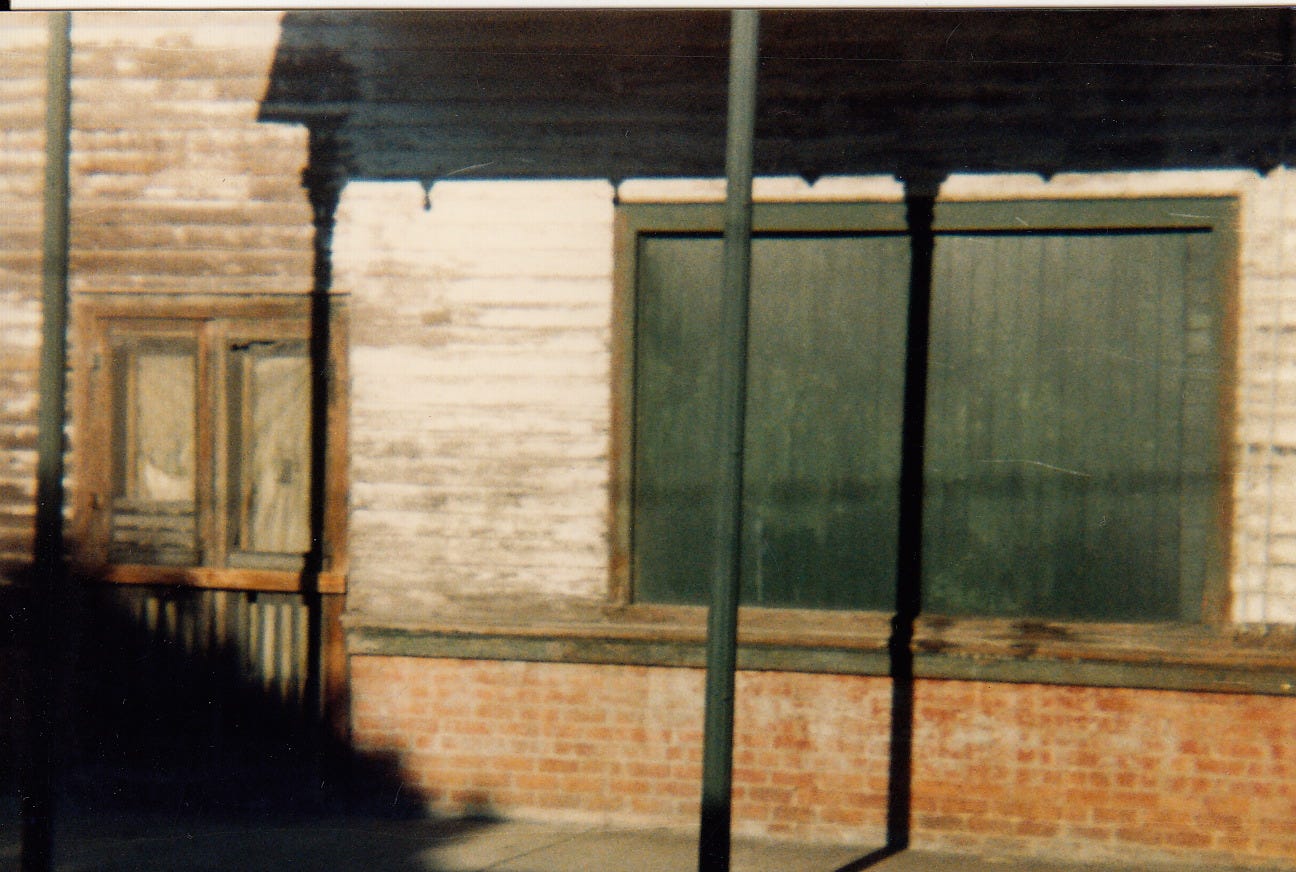
The gasp of the air brakes, the hot dirty smell of the engine.
The packed bus pulls out of LA at midnight. A lively young fellow who goes by the moniker of DJ Chrome, strikes up a conversation with me. “I like soul music,” he says, “... U2, Pink Floyd.” Then he falls asleep, using my shoulder as a pillow.
At dawn in Phoenix two filthy, hairy desperadoes board the bus. They are dressed identically in hooded sweaters, black jeans, leather jackets and studded belts. One of them twitches convulsively and carries a small attache case. The other has a huge boil on his face. His partner sometimes strokes it, along with other parts of his body. They commandeer the back seat, where they kiss and caress each other.
My neighbor is replaced by a young man attired in a stonewash jean-suit and Cornhuskers baseball cap. He continually pokes me in the ribs with his elbows and proceeds to nourish himself upon a packet of foul-smelling orange chips, forcing me to bear olfactory and auditory witness to the mechanics of his digestive system as he crunches and slurps. When he reaches the bottom of the bag he shakes it, raises it aloft and funnels it into his mouth, catching all the crumbs and powdery bits, intent upon wasting nothing of this sickening snack.
The man who keeps hanging over the seat in front of mine eventually asks where I’m from. “Los Angeles,” I say. End of conversation. I guess he doesn’t like LA. Which seems to be the consensus. Beyond the city limits one rarely finds anything but animosity directed towards the city and its environs, especially from the denizens of other big cities, notably from New Yorkers, and especially from San Franciscans, who consider it their civic duty to despise their sprawling cousin down the coast and everything they imagine it stands for. But this animosity goes unreciprocated. It might just be a case of empire envy, a begrudging acknowledgement of cultural power shift.
Babies wail incessantly. The overheated bus crawls through New Mexico, giving me plenty of time to reflect upon how I’ve wasted my life. But there’s still time, right? This is just the opening passage; but the beginning, without one’s noticing, soon overlaps with the middle and becomes the end.
Outside a McDonald’s in Roswell the two desperadoes kiss openly. They are booted off in El Paso for making lewd threats to a little girl.
The bus is virtually empty but it’s impossible to sleep because it vibrates so much as it passes through a dusty landscape of plateaus, oil wells and sheep. Cattle trucks pass by with shit and piss spilling out of them. The desolations of Van Horn and Fort Stockton... Sonora... Sheffield… the lovely little town of Balmorhea. Clouds in a clear blue sky.
It takes a long time to thaw the boneless chicken breast sandwich I order for lunch at a truck stop, and I don’t enjoy hearing the waitress’ account of the procedure.
The bus jerks along the highway. Across the aisle a clean-cut Caucasian man reads the chapter titled ‘The Perfect Penitent’ in C.S.Lewis’s Mere Christianity. Behind me, a couple of hyperactive brats eat noxious-smelling savory snacks, play loud video games and kick the back of my seat. A blind man sits in front of me. His wife leads him around at the rest stops with his arm on her shoulder. The lights stream by. Somebody is snoring, somebody else is snorting, one passenger is gibbering in his sleep, another is gibbering awake. Eventually I doze off and awake at dawn with a slow and sweaty white man from New Orleans in the seat next to mine. I have to contend with his thigh while, with great enthusiasm, he describes the fun-filled world of Mardi Gras.
getting on and off city buses and staggering around ugly neighborhoods until nausea has me firmly in its grip
At 9am the bus arrives in San Antonio. I walk around with much unchecked bile spilling out, cussing out strangers barely beneath my breath, getting on and off city buses and staggering around ugly neighborhoods until nausea has me firmly in its grip. There are some stables near the railroad depot, with horses and buggies sitting outside. I lie down on a patch of grass and fall asleep.
When I awake, the sun is sinking. I amble back downtown, where, along the river walk San Antonio’s own Mardi Gras festivities are taking place, so slight as to be hardly noticeable. In the venerable Esquire bar, a little Mexican woman in a blue dress hails me and asks me to let her know where I’ll be standing so she can buy me a drink - a prospect that excites my amorous propensities. But she never joins me. She sits in a booth with a baby in her arms and a man by her side.
A patron standing next to me at the long bar - one of the longest in the country - complains about drinking on an empty stomach. I am delighted to be addressed by a local, but that is the extent of our conversation. I depart into the night, the streets soft and silent, architectural atrocities that are visible during the day now muted.
Standing in line at the bus station I fall into conversation with a lad called John who has been on the bus from LA to San Antone, accompanied by his Argentinian girlfriend. He’s wearing a ‘These Colors Don’t Bleed’ T-shirt in an unconvincing display of patriotic pride. He’s clearly not the gung-ho type and is presumably sporting this sentiment in the hope of blending into middle America. His girlfriend, a pretty redhead, is no longer with him. She was removed earlier in the day, after the bus I alighted from was boarded by immigration agents in Seguin (“I’m goin’ to leave Seguin, be just like a submarine,” as Little Hat Jones sang). They had been on their way to New Orleans to enjoy Mardi Gras together. Now she’s in the San Antonio jail, from where she will be escorted to the airport and back to Argentina.
The lad is in an understandably despondent state. I attempt to console him as he sits beside me on the bus. He laments that it would be impossible to adequately describe the desperadoes, whom he refers to as the Manson Twins, to his friends back home in LA. In the wake of his girlfriend’s deportation he rented a room in a San Antonio hotel, purely in order to take a shower. He went for a drink in a bar but the barkeep refused to serve him because he was wearing a headband. “If I serve you then I’ve got to serve all the Indians,” was the explanation.
In the middle of the night there’s a long stopover in the Houston bus station. One malodorous traveler cackles demonically and sports a baseball cap bearing the legend No Money No Honey; another man wears one stating No Money No Women; another wears one adorned with the words Mass Confusion. Another man wears two pairs of trousers and a pair of brown loafers, the edges of which are painted with a thin strip of white. He claims to be bound for Las Vegas. It’s hard to tell if he’s laughing or crying. “If I ever get out of Texas,” he says, “I’ll blow my brains out.” This sentiment is upsetting to John, who has just about had his fill of the Lone Star state of mind.
As the luminous Houston skyline recedes the bus driver speaks into his microphone: “If you’re too cold, then snuggle... if you’re too hot, then snuggle... if you can’t find any one to snuggle with, sorr-eeee,” eliciting a laugh even from the attractive sullen girl sitting next to me, the only one of my transient neighbors who refrains from bodily contact.
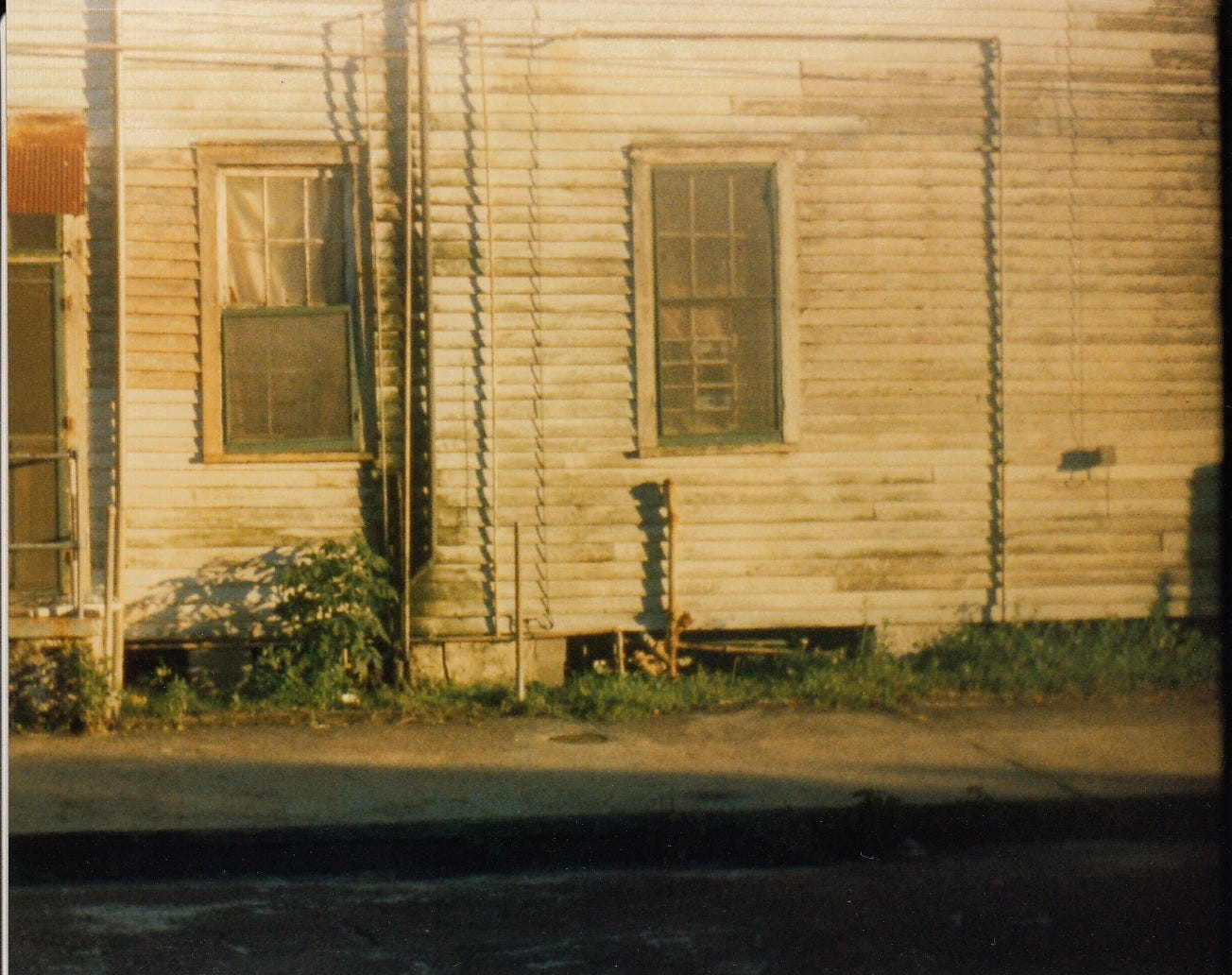
New Orleans, known as the Crescent City: a moist and humid slit, dripping with all the pleasure that has been put into it. I arrive to find Eliot and his girlfriend, Delia, asleep in an Airstream trailer parked in the untended garden of a house by the railroad tracks, by the river. Though I barely know them and they are not expecting me, they welcome me into their home, with Eliot sprinkling volcanic ash on my head as a welcoming rite.
For a year, before settling in New Orleans, Eliot traveled around the country, filling his trailer with books, musical instruments, shells, a Victrola, and other artifacts. Classed as mentally unsound, he subsists on government checks and resides in a ramshackle house on Tchoupitoulas street.
As a compulsive hand-washer, I find the absence of running water to be problematic. I prevail upon their neighbors, David and Kate, for a bath. They are both artists, from New England, and have a refreshing purity and sanity about them. David speaks reverently of both Washington Phillips and John Clare. I would rather be staying with them.
Amid a beer-swilling swarm of yahoos my hosts and I follow the Isis and Tuck parades along St Charles some forty blocks. I successfully manage to lose my new friends and drag myself footsore to the river and from there all the way back along the broken-down landscape of Tchoupitoulas street after dark. Later Eliot and I drive around in his battered pink Cadillac, with his girlfriend sulking in the back. I tell him that I’m sick of the sound of his voice. We drive up Rampart to St Claude in search of The Saturn bar, can’t find it, and wind up in the Quarter, drinking coffee. Eliot enters into a conversation with another patron, who asks him how he gets by. After half a minute of listening to Eliot’s explanation the patron averts his eyes. “I don’t want to hear anymore,” he says.
I take my rest on a recliner in the cluttered front room of the house. Peacock feathers are strewn throughout the room. Eliot’s logic dictates that what is bad luck for other people is good luck to him. Every time a car drives by the building vibrates.
On Mardi Gras morning Eliot wakes me up with a cup of coffee, with which I wash down a blotter of acid. Downtown, I walk through the crowded, costumed streets. At Lee Circle I am confronted by the disturbing sight of hundreds of pastel-clad jocks and their female counterparts waving beer cans in the air, dancing to ‘Hang On Sloopy.’ I can’t take it anymore. A woman sitting on the porch steps of a house on Magazine street calls out to me, “why are you laughing?” I hadn’t realized I was.
Back at the house, Donald and Julie invite us over. Julie’s brother Owen shows up. At a tender age he was in a celebrated college rock band but he tired of it and is now pursuing a career in academia. I can’t stop staring at his girlfriend, a slender brunette who wears a dress with white leggings and old-fashioned shoes. In that room, among these people, I am completely at home, and wish it were my home. At midnight when the last floats from the last parade pass by on their way back to the shed, we run outside, and the tractor drivers wave at us. Owen and his girlfriend ride away on a bicycle together. It seems an idyllic existence down there. I lie on the recliner while Eliot messes around the room. He doesn’t wash, drinks cheap beer, and is very much engaged by the world, or life at least. I am beginning to respect him and I’m sorry to be leaving.
Buried alive in the Gravehound…
I like many things about your posts, but I love the way you drop esoteric blues men references into the story. This time Little Hat Jones. Thanks.